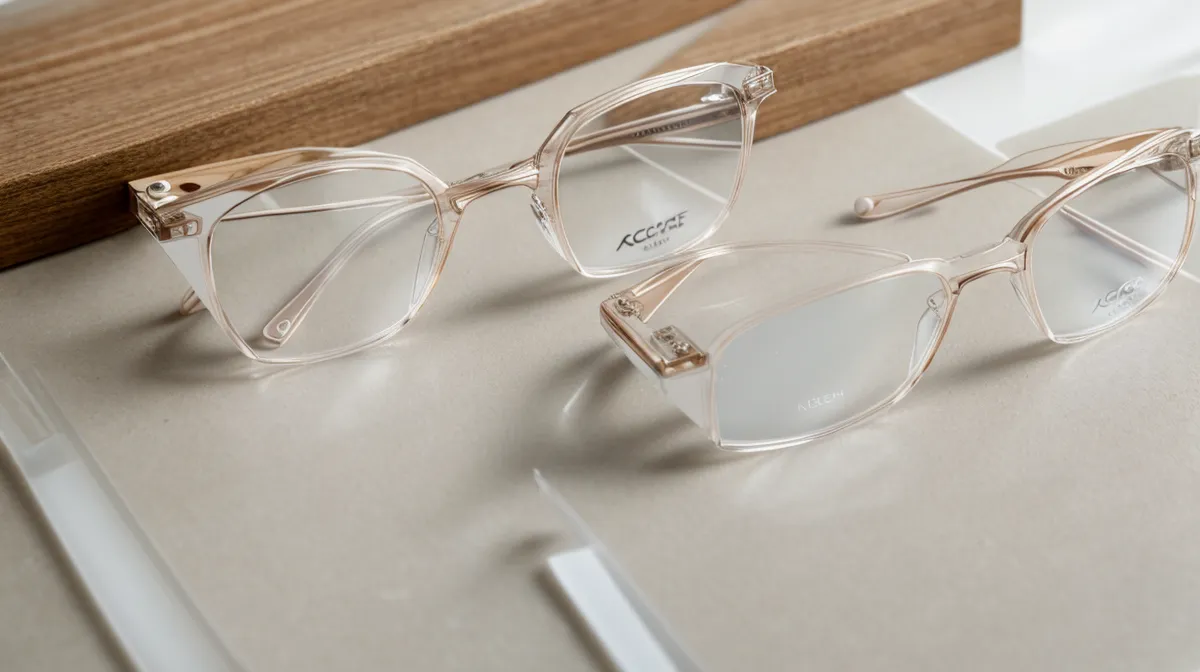
A ruler pressed against the bridge of your nose costs nothing and takes under a minute. A webcam tool that measures your face against a library card takes longer, needs decent lighting, and still shouldn't be the last word on the number. For a −5.00 prescription with a touch of astigmatism, that last part matters: get the pupillary distance wrong on an online glasses order and the lens won't center on the visual axis, no matter how good the webcam or how sharp the ruler markings are. The short version: run the digital tool first, confirm it by hand, and skip the second check only if the prescription is mild enough that a couple of millimeters wouldn't matter anyway. Yesglasses' own onboard PD tool is a decent stand-in for the whole category of webcam measurement — useful, imperfect, and worth checking against something else before an order goes out.
Call it a copyediting habit: seven years of logging every online optical order — shop, date shipped, what the listing promised against what actually showed up — makes a person suspicious of any single number a website hands over without a source attached. The pupillary distance field is the one I flag hardest, because a decentered lens produces the visual equivalent of a dropped clause: nothing announces itself, and the whole page still reads wrong.
Frame try-on kits don't solve this either. Warby Parker's home try-on program looks like an easy way to sample fit before paying, until the frame selection for anything past a −4 sphere thins out to fewer than two pairs worth trying. When a strong prescription already limits which frames show up in a try-on box, the PD entered on whatever pair does get ordered has to be right on the first attempt — there's no shoebox full of backups sitting on the porch as a plan B.
Two Ways to Find Your Pupillary Distance Number
The 1.67 high-index lenses I order for every strong prescription keep the edge from looking like a hockey puck, but that thinner profile leaves less room for a centering mistake than a cheaper, thicker lens would — proof that prescription accuracy depends on the PD field a lot more than the sales page lets on.
Two ways handle your pupillary distance well enough for most online orders. The term itself just means the space between the centers of your two pupils, measured in millimeters — a different number from the frame's bridge width or lens width, even though all three sit on the same order form and get mixed up constantly. The manual version uses a mirror and a millimeter ruler: close one eye, line the zero mark up with the open pupil, switch eyes, read the second number, and hope your hand didn't drift. The digital version, the one Yesglasses and most competitors run through a browser, asks you to hold a standard card — the same size across nearly every debit and library card thanks to the ISO 7810 spec — against your forehead while a webcam calculates the distance using the card's known length as a reference. The two readings don't always land on the identical millimeter — mine have disagreed by half a millimeter more than once — which is exactly why one number alone shouldn't be the one you submit with an order.
An EyeBuyDirect order settled my confidence in the ruler method for good: the frame listing gave an 18 mm bridge measurement, and my own caliper reading across the same spot landed on the identical number without rounding either way. Astigmatism complicates a different part of the form — cylinder and axis, not PD — and getting the toric fit right on that pair is its own separate headache I won't get into here; PD stays the same no matter what the rest of the prescription looks like.

Why Two or Three Millimeters Wrecks a Strong Prescription
Two to three millimeters is the threshold where an incorrect pupillary distance entry stops being trivial: enough prismatic displacement to produce real eye strain and headaches on a strong prescription like mine. That's optical geometry, not marketing language. The lens has an optical center engineered to sit directly over the pupil, and every millimeter off from that point bends light through an angle nobody asked for — the same way a badly kerned headline pulls the eye toward the wrong word first.
Symptoms show up fast on a strong prescription: mild but constant eye strain, a subtle "squished" quality to depth perception, a habit of tilting your head to find the sweet spot. On a low prescription, the same error might pass unnoticed for months. That gap in consequence is why the PD field matters more for prescription sunglasses for driving than for a spare pair of readers — one distorts your view at seventy miles an hour, the other just makes fine print slightly fuzzy.
Does Your Optician Already Have to Give You the Number?
Most opticians are required to hand over the pupillary distance on request, the same way they're required to hand over the rest of a prescription — sphere, cylinder, axis, and PD are treated as one document, not a proprietary secret meant to keep patients ordering in-store. A phone call to the office usually gets you the clinical number without any card-on-the-forehead routine at all.
Verifying that number against the original paper script is worth doing no matter which shop you use, the same way I'd never submit a contact lens order without checking base curve and diameter against the card the doctor actually signed. Insurance can complicate the ask — an out-of-network vision plan sometimes wants the PD listed on its own reimbursement form rather than whatever the digital tool spit out — so it helps to know which number a claim actually needs before you order. None of this is medical advice; it's paperwork hygiene, the same kind I'd apply to any form with a blank field.
A reader named Fletcher Nwankwo once emailed me his subscription-cancellation story formatted like a bug report — timestamped, numbered steps, no wasted words — after a piece I wrote on auto-renewal traps, and pausing a contact lens subscription runs on the same logic as chasing down a PD number: don't trust the account page, get the confirmation in writing. That's the same instinct that makes me press the ballpoint hard enough to dent the notebook page on the first order entry of a new year, a habit that outlasts whatever interface each shop happens to be running that month.
The Sequence That Beats Ruler-or-Webcam Alone
One friend of mine, the one who spends most weekends cycling the Jedediah Smith Memorial Trail, ordered a pair from an online shop last year and left the PD field blank, trusting the lab to "figure it out." It didn't. She lived with a low-grade, constant headache before finally sending the pair back and starting over with a number she'd measured herself. That comparison matters more than ruler-versus-webcam ever will: a guessed PD against a checked one.
So the verdict isn't really ruler or webcam — it's sequence. Use the webcam tool first if you want a fast starting number; trust the ruler-and-mirror check over the software the moment the two disagree; and call the optician's office only when the prescription is strong enough that a two-to-three-millimeter miss would actually hurt. A mild correction can probably get away with just one method. Mine can't.
None of this lives in isolation in my spreadsheet, either. The same log tracks which contact lens replacement schedule I'm mid-cycle on, which shop's coating held up past the first few wears, and which order needed a follow-up email before anyone fixed it. PD just happens to be the line item most likely to turn an otherwise fine order into an expensive drawer ornament.